On a hot summer day, few things are more frustrating than hearing your air conditioner run nonstop while your home keeps getting warmer. It’s easy to assume the system has completely failed, but that’s not always the case.
In the Salt Lake Valley, several different problems can prevent an AC from cooling properly, and many of them share the same warning signs.
So, how do you know what’s actually causing the problem?
This guide walks you through the most common causes of AC not cooling in the Salt Lake Valley, explains what you can safely check yourself, and helps you know when it’s time to call a professional.
What to Check First When Your AC Stops Cooling

Before scheduling an AC repair, there are a few simple things you can check yourself. These quick steps take only a few minutes and may help identify or even resolve some of the most common cooling problems.
- Thermostat Settings: Confirm the thermostat is set to COOL mode, the fan is set to AUTO, and the desired temperature is below the current room temp. Incorrect thermostat settings can keep the air conditioning system from entering cooling operation, and a fan set to ON will blow uncooled air continuously and feel like a cooling failure. Also check that the thermostat reading matches the room, and replace the batteries if the display is blank.
- Circuit Breaker: Go to your electrical panel and check the breaker labeled AC. A tripped breaker is one of the top causes of AC cooling failure, and it’s often easy to miss. A tripped breaker or blown fuse can keep the air conditioning system from running at all, not just from cooling.
- Outdoor Condenser Unit: Walk outside and confirm the condenser is actually running. The air handler inside may be blowing while the outdoor unit sits completely off. If the condenser is silent or not spinning, the system cannot cool.
- Supply Vents: Walk through your home and check that supply vents are all open and there’s no furniture, rug, or storage blocking them.
These four checks take less than five minutes. If everything looks normal and the system still is not cooling, the reasons your AC won’t cool go deeper than a quick reset can fix.
A Dirty Air Filter Is More Damaging Than Most Homeowners Realize
A clogged air filter is one of the easiest AC problems to overlook, but it can also cause some of the biggest cooling issues. As dust, dirt, and debris build up, the filter can restrict airflow across the evaporator coil and create poor airflow through the hvac system. An air conditioner not cooling effectively is often due to airflow restrictions, and a dirty filter is one of the most common reasons it stops cooling efficiently.
What feels like a refrigerant problem or even a failing compressor is often much simpler. In many cases, the only issue is a filter clogged with dust, dirt, or pet hair that hasn’t been cleaned or replaced in several months.
On the Wasatch Front, that replacement schedule can come sooner than many homeowners expect. Replacing air filters every 30–90 days improves AC efficiency, though cottonwood season, construction dust, and Utah’s dry summer conditions can clog them faster. Even if a filter might last 30–90 days in a milder climate, it may need attention much sooner during a Salt Lake Valley summer.
Why Restricted Airflow Causes Bigger Problems
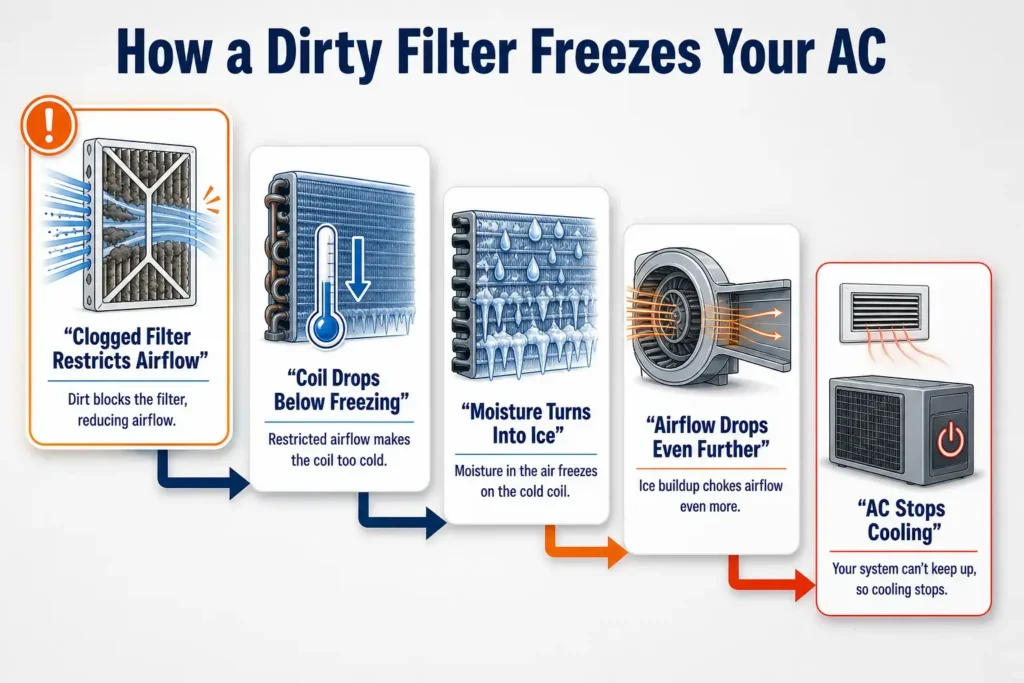
A clogged filter does more than reduce airflow. It can trigger a chain reaction that affects the entire cooling system. Restricted airflow across the evaporator coil causes the coil temperature to fall below freezing, allowing moisture in the air to turn into ice.
Once the coil freezes over, airflow drops even further, and your AC may stop cooling altogether. Frozen evaporator coils usually indicate either airflow issues or low refrigerant levels, though in many cases a neglected air filter is where the problem begins.
The U.S. Department of Energy recommends checking filters regularly, especially during periods of heavy AC use. In the Salt Lake Valley, checking your filter once a month during the summer is a simple habit that can help maintain proper airflow, prevent the coil from freezing, avoid unnecessary AC repairs, and keep your system operating efficiently.
READ MORE: How Often You Should Change Your Air Filter
Frozen Evaporator Coils Can Shut Down Cooling Entirely
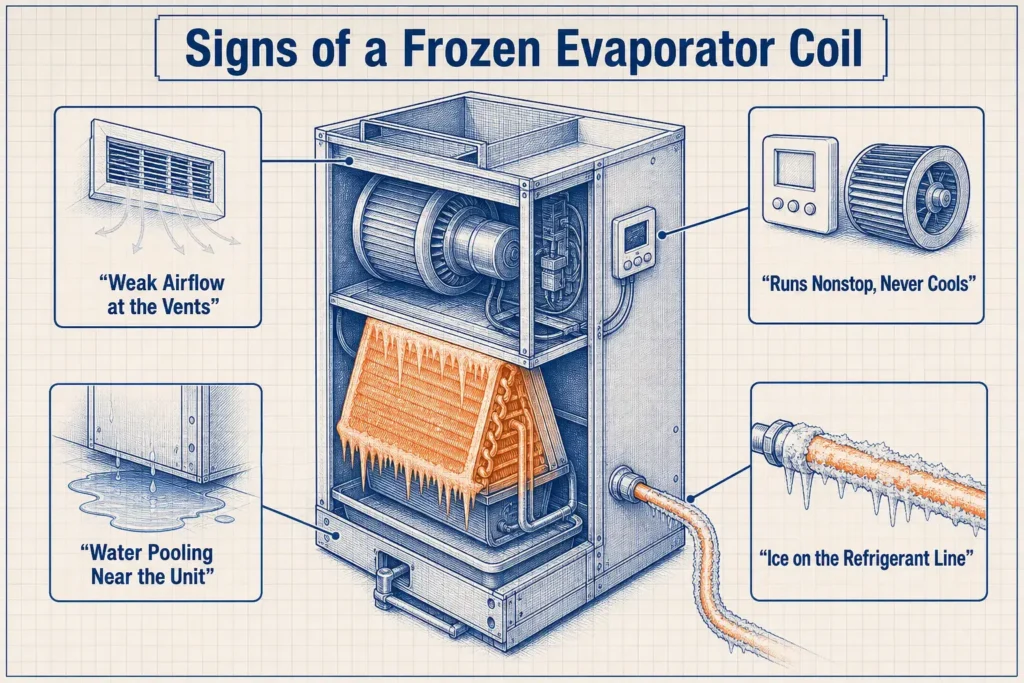
A frozen evaporator doesn’t only reduce the performance of an air conditioner; it can leave the system running but not cooling. When ice builds up across the coil surface, airflow through the system gets blocked entirely, and that can stop it from blowing cold air even though the blower is still on.
One thing to note is: If you know how air conditioners work, this problem becomes easier to recognize. In most cases, restricted airflow, a dirty filter, or low refrigerant are the most common causes, and frozen coils disrupt the cooling process by preventing normal heat transfer at the evaporator.
[Image Placeholder: ice buildup on evaporator coil refrigerant lines inside residential air handler unit]
How to Tell If Your Coil Is Frozen
Below are some of the most common signs that your evaporator coil may be frozen:
- Ice visible on the refrigerant line running from the air handler, which usually points to restricted airflow or refrigerant problems rather than a frozen coil by itself.
- Water pooling or dripping near the indoor unit as ice melts between cycles.
- Weak or barely-there airflow at supply vents throughout the home.
- The system running continuously without dropping the temperature.
The coil itself sits inside the air handler, so you may not see it directly. Visible line icing, however, is a useful clue that the coil has frozen over.
Safe Steps to Thaw a Frozen Coil
If you suspect your evaporator coil has frozen, there are a few safe steps you can take before restarting your system. These include:
- Switch the thermostat to fan-only mode, or turn the system off entirely to protect key components while the ice melts.
- Let the coil thaw for two to three hours.
- Place towels around the indoor unit to catch any water as the ice melts.
- Replace the air filter before restarting.
- Turn the system back on and monitor it.
If the coil freezes again within a few hours, stop running the system. A refreezing coil can point to low refrigerant levels and should be checked by an HVAC professional. Letting the AC continue to run with a frozen coil puts extra strain on the compressor, and compressor failure is one of the most expensive outcomes of ignoring this problem.
Low Refrigerant and Refrigerant Leaks Always Require a Pro
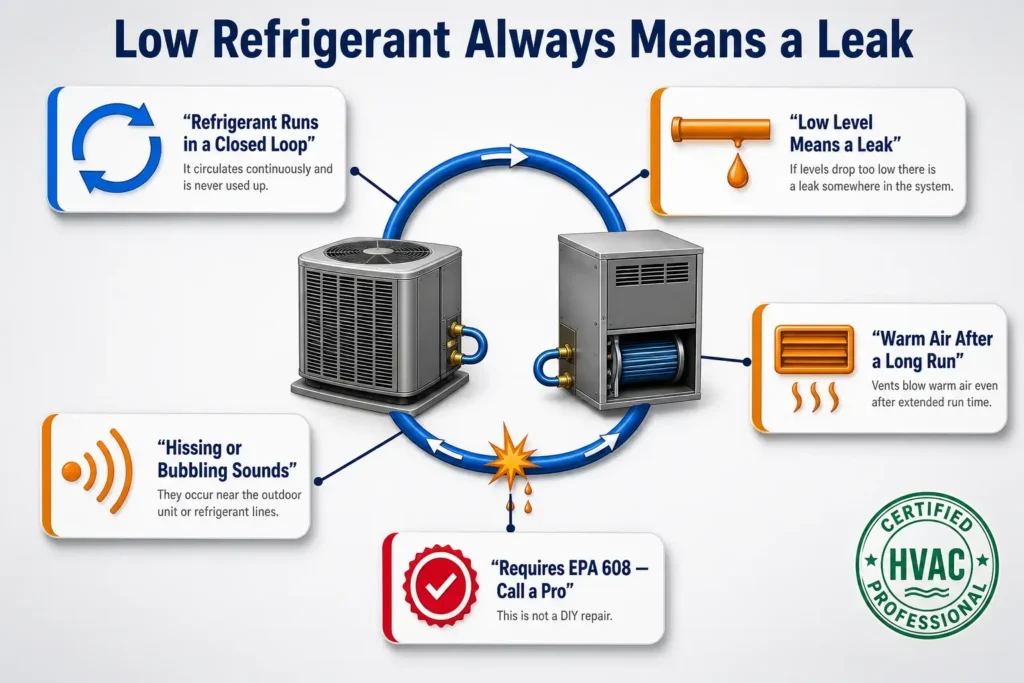
The refrigerant drives the cooling process by removing heat from the air inside your home and carrying it outdoors. When its levels drop, the system loses its ability to cool, no matter how long it’s running.
One important thing to note is that the refrigerant in a cooling system doesn’t get used up. It keeps circulating in a closed loop. And, if the levels drop too low, then there’s a leak somewhere in the system. A damaged refrigerant line or another leak point can interrupt cooling efficiently even if the AC keeps running.
Common signs of a refrigerant leak include:
- Warm air blowing from vents even after extended run time.
- Hissing or bubbling sounds near the outdoor unit or refrigerant lines.
- Ice forming on the evaporator coil or the lines running to the air handler.
Low refrigerant levels prevent the system from cooling efficiently, so these warning signs should be checked promptly.
Handling refrigerant requires an EPA Section 608 certification. This is not a DIY repair, and it’s illegal to handle refrigerant, repair refrigerant leaks, or recharge an AC system without the proper certification.
Oftentimes, you may be told that simply adding more refrigerant will solve the problem. While that may restore cooling temporarily, it doesn’t address the underlying issue if there’s a leak in the system.
The refrigerant will escape again, the compressor will continue operating under stress, and the evaporator coil will keep underperforming.
Why Fixing the Leak Comes First
The Energy Star guidance on air conditioner efficiency reinforces that proper refrigerant charge is one of the most direct factors in system efficiency and operating cost. A licensed technician or professional HVAC technician must find the leak, repair it, and then recharge the system to the manufacturer’s specified level. Skipping the repair step just delays the same failure.
At SameDay Heating & Air, our technicians identify the source of the leak, complete the necessary repairs, and recharge your system to the proper manufacturer specifications so it cools efficiently and reliably again with the proper charge.
Talk to a Licensed HVAC Technician
Common Outdoor Condenser Problems Salt Lake Valley Homeowners Should Know
The outdoor condenser coil and fan work together to pull heat energy out of your home and release that heat outside, but blocked condenser units prevent the air conditioner from releasing heat effectively. In the Salt Lake Valley, seasonal debris, extreme summer temperatures, restricted airflow, and dirt and grime on condenser coils that reduce heat transfer can all interfere with the AC’s performance. When that happens, your AC may keep running, but it will struggle to cool your home effectively.
[Image Placeholder: Outdoor condenser unit with cottonwood seeds packed densely into the condenser fins, Salt Lake Valley residential backyard]
Cottonwood Seeds and Seasonal Debris on the Wasatch Front

If you live in Sugar House, Holladay, Millcreek, or anywhere in the Salt Lake Valley, you already know what May and June look like. White, fluffy cottonwood seeds drift through the air like snow and settle into every surface they touch. What most homeowners do not realize is that those seeds land directly into the condenser fins and can block airflow almost completely within days.
This is one of the most common causes of AC performance drops across northern Utah, and it is one that most general HVAC content never mentions. A system that cooled fine in April can struggle by Memorial Day simply because the condenser coils are buried in cottonwood debris. When coils are packed with debris, the system cannot release heat properly and stops cooling efficiently.
Routine coil cleaning is a reasonable DIY maintenance task that can improve efficiency if you approach it carefully. To remove the debris without damaging the unit:
- Turn off the power at the disconnect box before you begin.
- Use a garden hose with low water pressure to rinse the condenser fins.
- Spray from the inside out to push debris away from the coil instead of forcing it deeper into the fins.
- Continue rinsing until the cottonwood seeds, leaves, and other debris have been cleared.
When cleaning the condenser fins, never use a pressure washer. The fins are thin aluminum and bend easily under high pressure, which creates a separate airflow problem. Reviewing AC efficiency and maintenance best practices before cottonwood season hits is worth the ten minutes it takes. Regular maintenance like filter replacement also helps preserve cooling performance.
Overgrown Vegetation and Physical Obstructions
Aside from cottonwood seeds, restricted airflow around the condenser is another common issue you should watch for. To help your system operate efficiently, keeping the outdoor unit clear with at least two feet of space around it is necessary for proper airflow around the condenser by trimming back shrubs, weeds, and other vegetation.
If the condenser fins are bent or damaged, a fin comb can straighten minor damage and restore airflow. But if you fail to keep the area open, poor airflow can reduce cold air output; and if the condenser fan is not spinning, or the unit is making grinding or rattling sounds, shut it down immediately and call a technician.
Running a condenser with a failing fan puts direct stress on the compressor. You don’t want to risk damaging your compressor because compressor replacement is one of the most expensive AC repairs you can face.
Ductwork Leaks and Blocked Vents Quietly Drain Cooling Performance
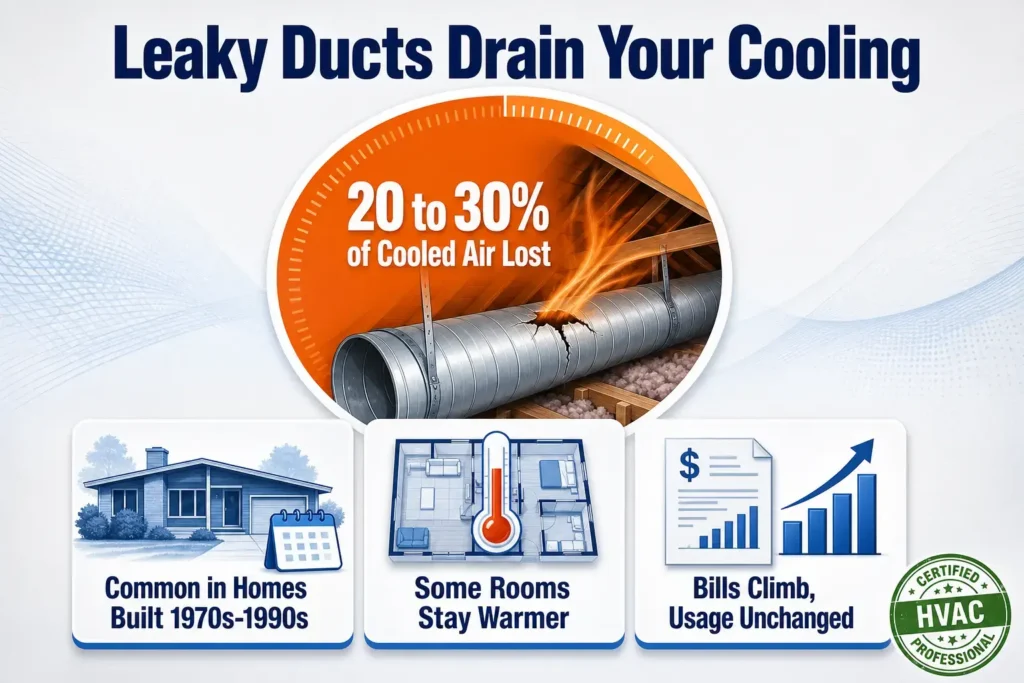
Even when the AC unit itself is working fine, cooled air can disappear before it ever reaches the rooms that need it. Leaky ductwork is a quiet efficiency killer, and it’s mostly common in homes built between the 1970s and 1990s. Poor insulation can also make it harder for cool air to reach living spaces, even when the equipment is operating normally.
Many of those older Wasatch Front properties have duct systems that were never designed for modern cooling loads, and decades of settling, temperature cycling, and deferred maintenance have only made those issues worse. In some cases, comfort problems also come down to whether the system was sized for the home’s square footage and insulation quality, not just the AC equipment itself.
It’s important to keep your ducts in good condition. Based on what our technicians regularly encounter, duct leaks are a common cause of poor cooling performance. In some homes, leaky ducts can lose 20 to 30 percent of cooled air before it reaches the living space.
That means your system may be working at full capacity while a significant portion of that output escapes into an unconditioned attic or crawl space, where it’s not needed.
To determine whether your ductwork could be contributing to poor cooling, watch for the following signs:
- Rooms that stay noticeably warmer than others despite similar vent placement.
- Weak airflow from specific supply vents while others feel normal.
- Energy bills climbing with no change in usage or thermostat settings.
How Blocked Vents Make Your AC Work Harder
Blocked vents create a separate but related problem. When supply vents are closed or obstructed, pressure builds up inside the duct system, and restricted airflow forces the system to work harder for less output. Furniture, rugs, and curtains blocking return air grilles are among the most common oversights in any home. Check every vent in the house, open any that are closed, and clear anything sitting directly over a return grille.
Duct sealing and insulation are professional repairs, but they carry a high payoff in older homes. Addressing these issues can improve airflow, reduce unnecessary strain on your system, and help your home cool more evenly.
Electrical Component Failures That Stop Cooling Dead
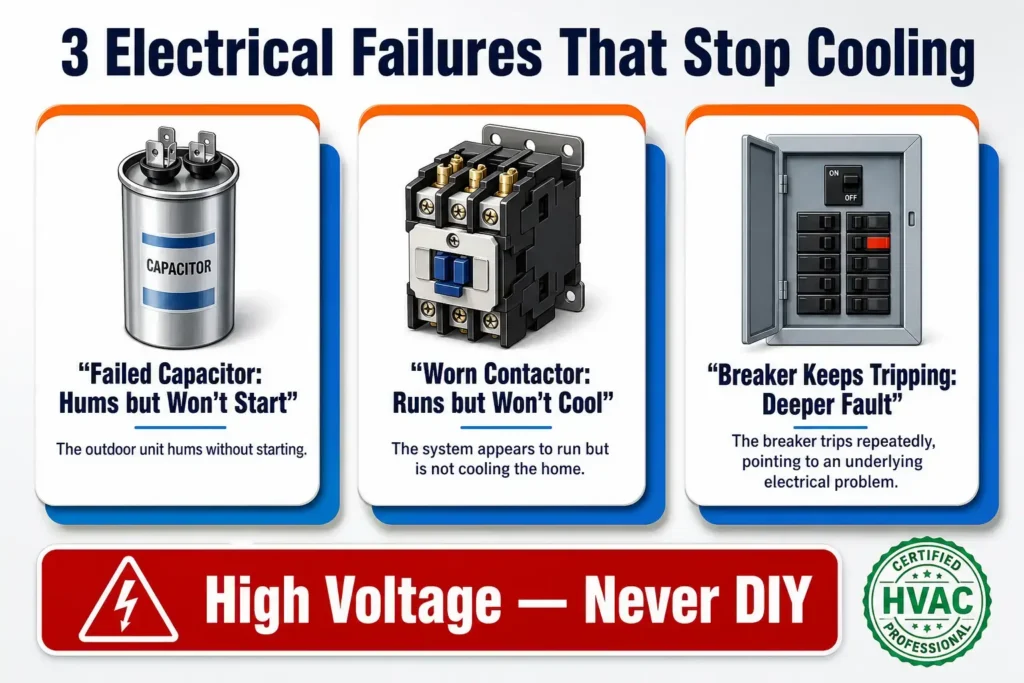
Electrical problems can prevent your air conditioner from cooling even when everything else appears to be working normally. Even when a fan or thermostat still seems to run, electrical issues can interrupt the system and usually need professional diagnosis as part of AC troubleshooting. If your system hums without starting, the outdoor unit won’t turn on, or the AC keeps shutting off unexpectedly, one of these electrical components could be the cause.
Capacitor Failure
Capacitors provide the electrical boost needed to start and run the compressor and fan motors. When a capacitor begins to fail, the outdoor unit may hum without starting, or the fan may spin briefly before stopping.
Utah’s intense summer heat accelerates capacitor wear. During extended heat waves, these components work much harder than they would in milder climates, making them one of the most common AC repairs our technicians perform.
Worn Contactor
The contactor controls the flow of electricity to the compressor. As the contacts wear down over time, the compressor may not receive the power needed to start. The result is an AC system that appears to be running but isn’t actually cooling your home.
Repeatedly Tripping Circuit Breakers
A circuit breaker that trips once may simply need to be reset, but a power surge can also trip the breaker or damage electronic controls, affecting the AC’s performance even after power is restored. However, if the AC breaker continues tripping, it’s usually a sign of an underlying electrical problem rather than the breaker itself.
Repeatedly resetting the breaker can make the situation worse. It may also lead to short cycling, where the system repeatedly starts and stops, placing unnecessary strain on the compressor.
When you notice any of these electrical issues, avoid trying to repair them yourself. Capacitors hold dangerous voltage even after the system is powered down, and contactor replacement involves live high-voltage components. If any of these symptoms match what you’re seeing, call a licensed HVAC technician, especially since repeated trips may point to a deeper electrical issue that should be professionally diagnosed rather than repeatedly reset.
How Utah’s Climate Affects AC Performance
Utah’s climate places unique demands on air conditioning systems. Combined with the region’s older housing stock, it’s one of the biggest reasons AC units in the Salt Lake Valley often work harder than those in many other parts of the country.
Elevation, Dry Heat, and What They Mean for AC Performance
The Salt Lake Valley’s climate puts extra demand on air conditioning systems compared to many other parts of the country. Higher elevation, dry air, and long stretches of summer heat all affect how hard your system has to work.
Here’s why:
- At roughly 4,300 feet above sea level, thinner air makes heat transfer slightly less efficient.
- Prolonged high temperatures keep your AC running for longer periods, and extreme outdoor temperatures can expose sizing limits even in systems that usually seem to cool fine.
- Intense UV exposure places additional stress on outdoor components throughout the summer.
So, is it normal for your AC to run more often during a heatwave? Yes. Even a properly functioning system may only maintain an indoor temperature that’s about 20°F cooler than the outdoor temperature. That’s a normal operating limit, not necessarily a sign that your air conditioner needs repairs, though when outdoor temperatures spike, an undersized system may still struggle even while operating normally.
If you’re trying to stay comfortable while your system catches up or you’re waiting for service, check out our guide on ways to stay cool during Utah summer heat waves.
When an Older or Undersized System Can’t Keep Up
Many homes throughout the Wasatch Front were built decades ago, and some still rely on aging or undersized air conditioning systems that struggle to meet today’s cooling demands. Air conditioners are sized in BTUs, and a unit that’s too small for your home’s cooling load may run almost constantly without ever keeping up.
Common signs your system may no longer be the right fit include:
- It runs almost continuously without reaching the thermostat setting.
- Certain rooms never cool as well as others.
- Repair calls become more frequent each summer.
- Energy bills continue climbing while comfort declines.
Unlike a dirty filter or faulty capacitor, this isn’t usually a repair issue. It’s often a sign that the system simply doesn’t have the capacity to cool your home efficiently anymore, and correct sizing depends on square footage and insulation quality, not age alone. If your home uses a heat pump, the same issue can also affect how well it switches into cooling mode.
Continuing to push an undersized or aging unit through another Utah summer can place excessive strain on the compressor, increasing the likelihood of a costly breakdown. In many cases, frequent repairs on an older unit are a sign replacement is the more practical and cost-effective long-term solution than forcing a system to work beyond its cooling load.
When to Handle It Yourself and When to Call a Technician
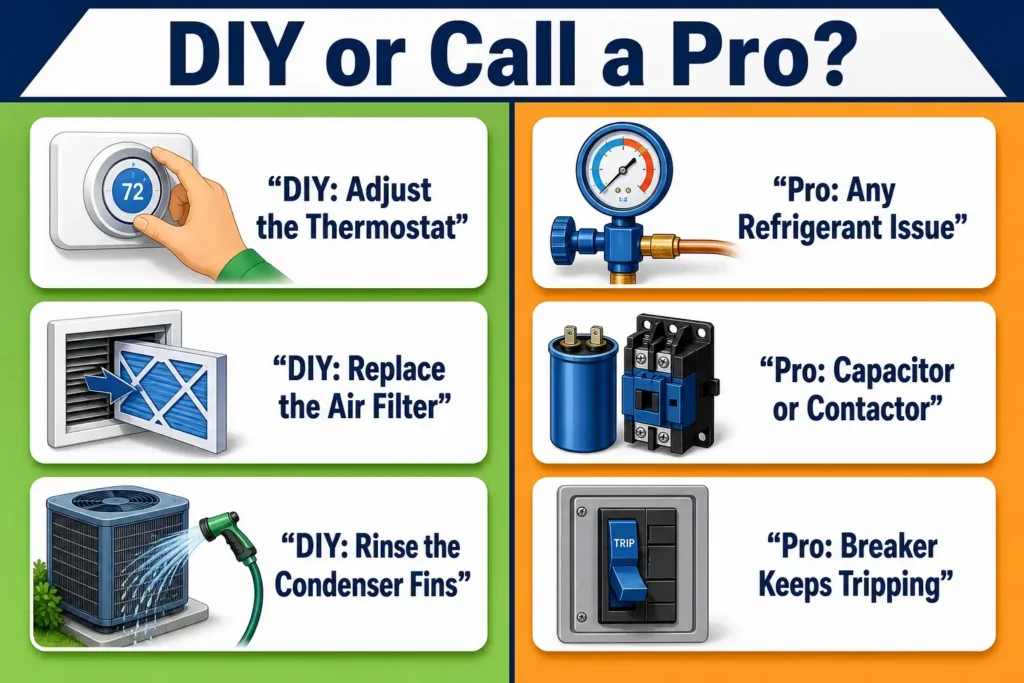
Some AC problems are safe to address on your own while others are not. Understanding the difference is especially important when temperatures are climbing past 100°F.
As a general rule, anything involving refrigerant, high-voltage components, or a system that keeps failing after a DIY fix belongs in a technician’s hands.
The following are what you should be able to handle by yourself:
- Checking and correcting thermostat settings.
- Resetting a tripped circuit breaker once.
- Replacing a clogged air filter.
- Rinsing cottonwood seeds and debris off the condenser fins.
- Clearing blocked or closed supply vents.
If you’re experiencing any of the following, call a technician right away:
- A frozen coil that refreezes after thawing, which points to a refrigerant problem.
- Any refrigerant issue, since handling refrigerant requires EPA certification.
- A capacitor or contactor failure.
- A condenser fan that will not run.
- A breaker that keeps tripping on the AC circuit.
- A system over 15 years old that is steadily losing performance.
For landlords managing Wasatch Front rentals, a non-cooling AC in July isn’t just a comfort issue for tenants. It’s a habitability concern, and delaying repairs can quickly lead to larger problems for both the property and the people living in it.
When choosing an AC repair company, look for technicians who understand the unique demands Utah’s climate places on residential cooling systems and can diagnose the problem accurately the first time.
SameDay Heating & Air has been serving homeowners and property managers throughout the Wasatch Front for decades. Our technicians understand the aging housing stock, the cottonwood seasons, and the added strain Utah summers place on cooling equipment.
If you need professional help, we provide expert air conditioner repair services to diagnose and resolve AC problems correctly. We also offer 24/7 emergency AC repair, so you can restore comfort as quickly as possible when your system fails during extreme heat.
Keep Your Salt Lake Valley Home Cool All Summer
Most AC cooling failures often trace back to a handful of fixable causes such as a clogged filter, a frozen coil, low refrigerant, a blocked condenser, or an aging system pushed past its limit by Utah’s heat. Catching any of these early prevents compressor damage and the far costlier repairs that follow a breakdown at peak summer.
At SameDay Heating & Air, we’ve helped homeowners throughout Salt Lake City and the Wasatch Front keep their homes comfortable for decades.
If your air conditioner isn’t cooling properly or you’ve noticed any of the warning signs covered in this guide, don’t wait for the problem to get worse. Contact our team, and we’ll dispatch a licensed HVAC technician to diagnose the issue and restore your home’s comfort as quickly as possible.
Questions Salt Lake Valley Homeowners Ask About AC Cooling Problems
Why Is My AC Running but Not Getting Cooler?
The most common causes include a dirty air filter, a frozen evaporator coil, low refrigerant, a faulty capacitor, or restricted airflow. Start with the simple checks first. If the problem continues, schedule a professional inspection.
Should You Turn Off Your AC If It Isn’t Cooling?
Yes. If your AC isn’t cooling, especially if you suspect a frozen coil, turn it off or switch the fan to ON. Continuing to run the system can place unnecessary strain on the compressor.
What Is the 3 Minute Rule for Air Conditioners?
Wait at least three minutes before restarting your air conditioner after shutting it off. This allows system pressures to equalize, reducing stress on the compressor and helping protect it from unnecessary wear.
What Is the Average Lifespan of an Air Conditioner?
Most central air conditioning systems last between 15 and 20 years with proper maintenance. As systems age, repairs become more frequent and efficiency declines, making replacement a more practical long-term investment.
What Is the $5,000 Rule for AC?
Multiply your system’s age by the estimated repair cost. If the total exceeds $5,000, replacing the unit is often more cost-effective than continuing to invest in an aging air conditioner.
How Often Should I Change My AC Air Filter?
Most homeowners should check their air filter every month and replace it every one to three months. During peak summer in Utah, filters may need replacing more frequently because of dust and cottonwood.
Why Is My AC Blowing Warm Air?
Warm air can result from thermostat settings, a dirty air filter, low refrigerant, frozen coils, electrical problems, or an outdoor unit that’s not operating properly. A professional diagnosis identifies the exact cause.
When Should I Call an HVAC Technician?
Call a technician if your AC still isn’t cooling after basic troubleshooting, if the coil repeatedly freezes, you notice refrigerant leaks, unusual noises, electrical issues, or the system frequently shuts itself off.